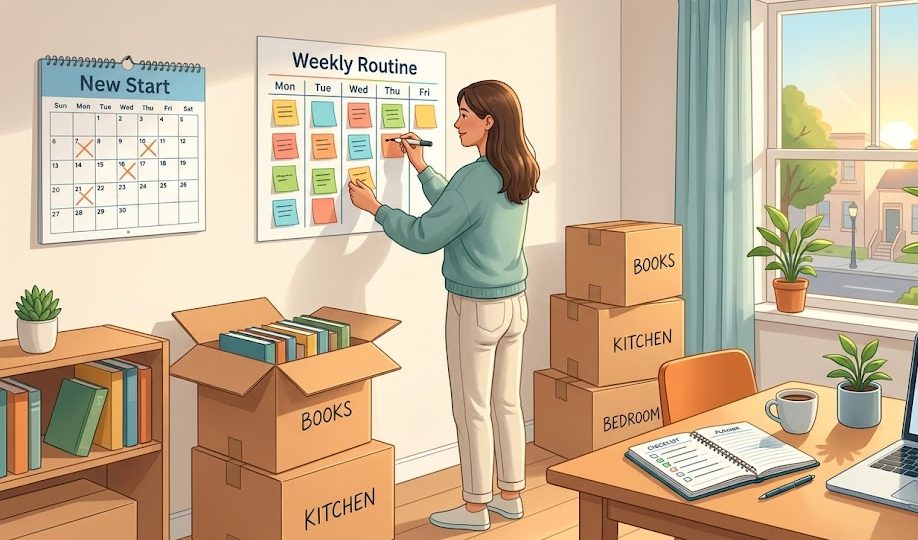
When life changes, your old routine may stop making sense. That does not mean you have lost your discipline.
A new schedule, job, home, study pattern, relationship, responsibility, or personal priority can change the rhythm of an entire day. Building a new routine starts by accepting the change and creating a structure that fits your current reality.
Daily routines often feel stable because many activities happen automatically. You wake up at roughly the same time, follow familiar preparation steps, travel to the same places, complete predictable responsibilities, and return to a familiar evening pattern. When one major part of life changes, that rhythm can suddenly disappear.
A new work schedule might affect your sleep and meals. Moving to a new home can change shopping, transportation, and household responsibilities. Starting a course can introduce new study periods. Even a positive change can leave you feeling disorganized because the habits that worked before were built around circumstances that no longer exist.
The answer is not to force your previous routine to continue unchanged. Instead, treat the transition as an opportunity to design a new daily structure around what your life actually looks like now.
Understand what has actually changed before rebuilding everything.
Map Your New Reality First
Before creating a detailed routine, spend a few days noticing how your current life works. Identify fixed commitments, flexible responsibilities, travel time, energy patterns, household needs, and the moments when you naturally have more or less focus.
This prevents a common mistake: creating a schedule based on what you wish your day looked like instead of what is actually possible.
Work, classes, appointments, travel, or other activities that happen at specific times.
Cleaning, shopping, exercise, errands, planning, and other tasks that can move.
Notice when you tend to feel alert, tired, productive, or mentally overloaded.
Include commuting, preparation, meals, and other activities that sit between major commitments.
Choose the Parts of Your Routine That Truly Matter
A major life change can tempt you to rebuild every habit simultaneously. That usually creates unnecessary pressure. Start with the activities that support your basic wellbeing and responsibilities.
Sleep
Protect a reasonably consistent sleep and wake pattern where your circumstances allow.
Food
Create dependable meal patterns instead of leaving every meal to last-minute decisions.
Responsibilities
Make sure essential work, study, household, and personal obligations have a place.
Recovery
Leave room for relaxation, relationships, hobbies, and time away from obligations.
Build Around a Few Habits That Give the Day Its Shape
When everything is changing, small predictable actions can provide stability. These are often called anchor habits because they help connect different parts of the day.
An anchor habit does not need to be impressive. Waking at a consistent time, preparing tomorrow’s clothes in the evening, taking a short walk after work, reviewing your schedule with breakfast, or resetting the kitchen after dinner can create useful transitions.
Morning anchor
Choose one repeatable action that signals the beginning of your active day.
Midday anchor
Use a meal, short planning check, or brief reset to create a natural pause.
Evening anchor
Create a small closing routine that helps separate today’s responsibilities from tomorrow’s.
Create a Routine That Matches Your Energy, Not Just the Clock
Time matters, but energy matters too. A task scheduled at the wrong point in your day may become much harder than necessary.
Use these for demanding work, study, planning, or tasks requiring concentration.
Good for routine work, errands, household responsibilities, or administrative tasks.
Reserve these for simpler tasks, preparation, relaxation, or your evening wind-down.
Your energy pattern may change during a transition. Give yourself time to discover the new rhythm rather than assuming that your old productive hours will remain exactly the same.
Reduce Decisions While You Are Still Adjusting
Transitions consume attention. You may be learning new systems, meeting new people, navigating unfamiliar places, or managing responsibilities that did not exist before. Adding too many new habits at the same time can make the adjustment harder.
Look for areas where you can create simple defaults. Repeating a few breakfast options, keeping a standard grocery list, preparing clothes in advance, or assigning household tasks to particular days can reduce the number of decisions you need to make.
“What should I do tonight?”
Every evening becomes a new decision.
“Tonight is my reset night.”
A familiar pattern makes the next action easier to recognize.
Design the Moments Between Responsibilities
People often focus on major blocks such as work, school, exercise, or sleep and forget the transitions between them. Yet these small periods can determine whether the entire day feels rushed.
Think about what happens immediately after waking, before leaving home, when returning from work, before starting an evening task, and during the final part of the night. Giving these transition points a simple structure can make the day feel more connected.
Start gently
Use a predictable first sequence rather than immediately reacting to every notification.
Prepare
Keep essential items ready so leaving home requires fewer last-minute decisions.
Reset
Give yourself a short transition between outside responsibilities and home life.
Close down
Reduce unfinished mental loops by preparing a few things for tomorrow.
Leave Space for Days That Do Not Go According to Plan
A routine should provide structure without becoming a source of guilt. Unexpected appointments, late work, tiredness, social plans, household problems, and other interruptions are normal parts of life.
If your routine only works on perfect days, it is probably too rigid. Create a minimum version of your routine that can survive difficult days.
Sleep: Protect the best sleep opportunity available.
Food: Keep meals simple rather than skipping them because the day is busy.
Responsibilities: Complete the most important obligation.
Reset: Do one small action that makes tomorrow easier.
Give Your New Routine Time to Become Familiar
Instead of expecting an entirely new routine to feel natural immediately, use a short adjustment period to test what works.
Observe
Notice where the schedule feels rushed, unrealistic, or naturally comfortable.
Adjust
Move tasks, simplify routines, and remove unnecessary steps.
Stabilize
Keep the parts that work and turn them into repeatable habits.
This is not a rigid rule. Some transitions require longer adjustment periods, while others settle quickly. The purpose is simply to treat the first weeks as a period of experimentation rather than a test of personal discipline.
Signs That Your New Routine Needs Adjustment
You are constantly rushing
Your schedule may contain too many activities or underestimate transition time.
You repeatedly skip the same task
The task may be scheduled at an inconvenient time or need to be broken into smaller steps.
You feel behind every day
Your daily workload may be larger than the time and energy realistically available.
You resist the routine itself
Too much rigidity can make a routine feel restrictive. Add flexibility where appropriate.
A New Routine Should Support the Life You Have Now
When daily life changes, it is natural to compare the present with the routine that used to work. You may wonder why you cannot maintain the same habits or productivity you had before. But a routine is built around circumstances, and when those circumstances change, the routine may need to change too.
Start by observing your new reality. Identify fixed commitments, flexible responsibilities, energy patterns, and transition periods. Then choose a few priorities that deserve protection and build simple anchor habits around them.
Keep the system flexible. Some days will be smooth, while others will require a simpler version of your routine. What matters is having enough structure to return to rather than expecting yourself to follow an identical schedule every day.
A successful routine is not one that controls every part of your day. It is one that helps important things happen without making everyday life feel unnecessarily complicated.
Give yourself time to experiment, adjust, and settle into the new rhythm. With a few dependable habits, realistic expectations, and enough flexibility for real life, a major change can eventually become a new normal rather than a constant disruption.